
How to Tell Real Jade From Fake: 7 Simple Tests at Home
Table des matières
Real jade — jadeite or nephrite — feels cool and stays cool longer than glass or plastic, has a hard, waxy surface that resists a fingernail, rings with a clear tone when tapped, and shows uneven, cloud-like internal texture under light rather than round bubbles. None of these tests alone is conclusive, but together they catch most obvious fakes before you need a lab.
Introduction
Buying jade online or in a shop means trusting a description you can't always verify on the spot. Before sending a piece back or asking for a lab report, there's a lot you can check yourself, at home, in a few minutes. The seven tests below use things most people already own — your hand, a fingernail, a phone flashlight — and each one tells you something different about whether a piece is likely genuine.

Why Jade Behaves Differently From Imitations
"Jade" is a cultural term that covers two different minerals: jadeite and nephrite. Both are made of tightly interlocking crystals, which is what gives them their unusual toughness — GIA notes that this interlocked structure is one of the reasons jade resists chipping better than many harder-looking stones. Common imitations — dyed quartzite, glass, serpentine, or plastic — don't share that structure, which is why simple physical tests on a piece of jade already tell you a lot.
How Do Jadeite and Nephrite Compare Physically?
Sources: GIA, Jade Quality Factors; Mindat.org, Jadeite Jade and Nephrite.
What Do Type A, B, and C Actually Mean?
Before testing a piece, it helps to know what you're checking for. Jadeite is classified by treatment, not by "grade": some sellers use a "Grade A/AA/AAA" label to make things easier for customers, but it isn't an official scale — the only classification recognized in the trade is Type A/B/C.
A GIA report identifies the material and flags treatment — it does not issue an A/B/C letter grade itself; that classification comes from the trade nomenclature described above.
Touch, Hardness, and Weight: Three Tests Anyone Can Do
These three checks rely only on your hands and a few seconds of attention, and they're a good starting point before moving on to light and sound.
Does It Stay Cool in Your Hand?
Hold the piece in your closed palm for about 30 seconds. Genuine jadeite and nephrite conduct heat well and feel distinctly cool at first contact, warming up more slowly than glass, resin, or plastic. This isn't proof on its own — some glass also starts out feeling cool — but a piece that warms up almost instantly is a bad sign.
Does It Resist a Fingernail?
Press a fingernail firmly against an inconspicuous spot on the jade. With a Mohs hardness of 6.0–7.0, jadeite and nephrite will not mark under fingernail pressure (fingernails sit around 2.5 on the Mohs scale). Softer imitations — resin, plastic, and some dyed soapstone — can show a faint mark.
Is It Heavier Than It Looks?
Hold the piece and compare its weight to what you'd expect from its size. Jadeite (density 3.30–3.38 g/cm³) and nephrite (2.90–3.03 g/cm³) are both noticeably denser than glass (about 2.5 g/cm³) or plastic. A jade bangle that feels surprisingly light for its size is worth a second look.
Light, Sound, Color, and Price: Four More Checks
Once you've checked temperature, hardness, and weight, these four remaining tests look at how it interacts with light and sound, and at what the listing itself tells you.
What Does the Surface and Interior Look Like Under Light?
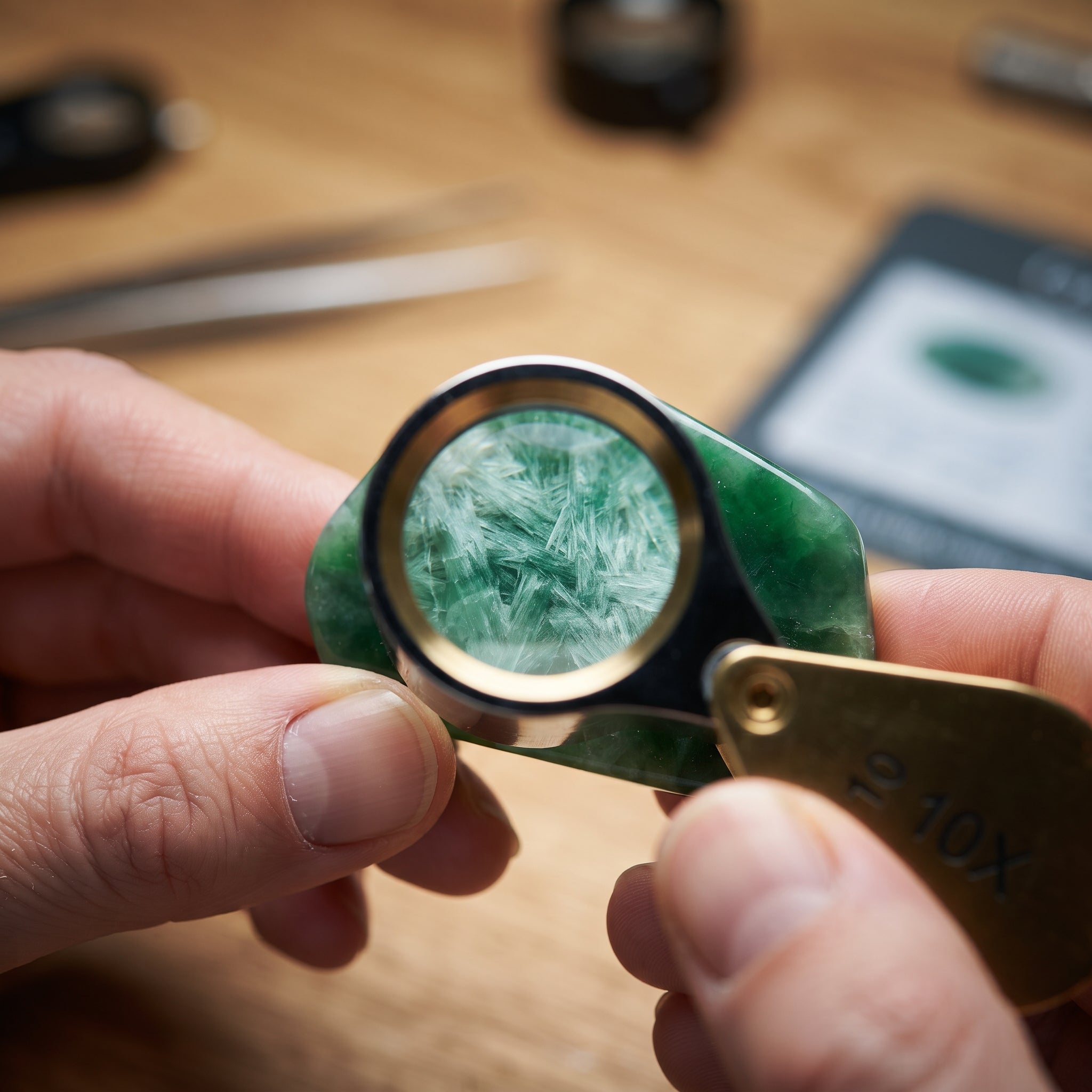
In a dim room, shine a phone flashlight through the stone at an angle. It shows an uneven, slightly cloudy, fibrous texture — sometimes with fine internal fractures — rather than a perfectly uniform glow. Round, evenly spaced bubbles usually mean glass; a flat, even color with no internal texture at all often points to dyed quartzite or resin.
Does It Ring When Tapped?
Suspend the bracelet loosely, or rest it on your fingertip, and tap it gently with another piece of jade or a small metal object (not a hard strike — you're listening, not testing durability). Untreated jadeite and nephrite tend to produce a clear, ringing tone thanks to their dense, interlocked structure. A dull, flat thud is more typical of resin-impregnated (Type B) material or plastic, where internal glue and fillers dampen the sound.
Is the Color Too Perfect?
Look closely at the stone, ideally with your phone camera in macro mode. It almost always shows some variation — faint mottling, deeper patches, or a slightly uneven tone. Color that is perfectly flat throughout, or that pools only inside carved grooves and hollows, is a sign of surface dyeing (Type C).
Is the Price Realistic for What's Claimed?
A piece advertised as natural, untreated jadeite (Type A) at a price far below market rate for comparable jade pieces is the single most reliable warning sign of all — cheaper to fake the stone than to fake the number. If a listing can't or won't confirm treatment type, that's worth asking about directly before buying.

When You Need a Lab to Be Certain
Everything above can be checked by anyone, at home, with things most people already own — no special equipment, training, or age required. A lab isn't a step to add to your own checklist; it's what a professional turns to when a truly final answer matters.
What Can FTIR and Refractometry Confirm That the Eye Cannot?
Home tests narrow things down, but they can't replace instrumental analysis. Gemological labs, including GIA, use techniques such as Fourier-transform infrared spectroscopy (FTIR) to detect the resin used in Type B treatment, and refractometry to measure the precise refractive index (around 1.66 for jadeite, 1.61 for nephrite) — figures too close to distinguish reliably by eye.
Why Does a Written Certificate Matter?
For a purchase where authenticity really matters, a written lab report naming the treatment type is the only fully conclusive answer. Shops that sell genuine jadeite and nephrite jewelry generally offer a certificate of authenticity alongside the piece, stating whether it's Type A, B, or C — asking to see one before buying is a reasonable and normal step.
Conclusion
No single home test proves a piece is genuine jadeite or nephrite, but taken together — temperature, hardness, light, sound, weight, color, and price — they will catch almost every obvious fake before you spend money.
FAQ
Can I really tell if my jade bracelet is real just by touching it?
Touch alone isn't conclusive, but genuine jadeite and nephrite stay cooler for longer than glass or plastic, which makes it a useful first check when combined with the weight and sound tests.
Why does tapping a bracelet against another stone help?
The dense, interlocked structure of an untreated stone produces a clear ringing tone, while resin-impregnated (Type B) material or plastic tends to sound duller because internal fillers absorb the vibration.
What's the difference between "Type A" jade and "Grade A" jade?
Type A is the correct term — it means untreated jadeite. "Grade A/AA/AAA" isn't an official gemological scale; if a seller uses it, ask what treatment type they actually mean.
Does a low price always mean the jade is fake?
Not always, but a piece sold well under market rate for the treatment type claimed is the clearest single warning sign — it's far easier to fake a price tag than to fake the stone.
Can these home tests replace a GIA report or a shop's certificate?
No. They help you flag an obviously fake piece before spending money, but only instrumental testing (FTIR, refractometry) in a lab, or a proper certificate of authenticity from the seller, can confirm treatment type with certainty.
Read more
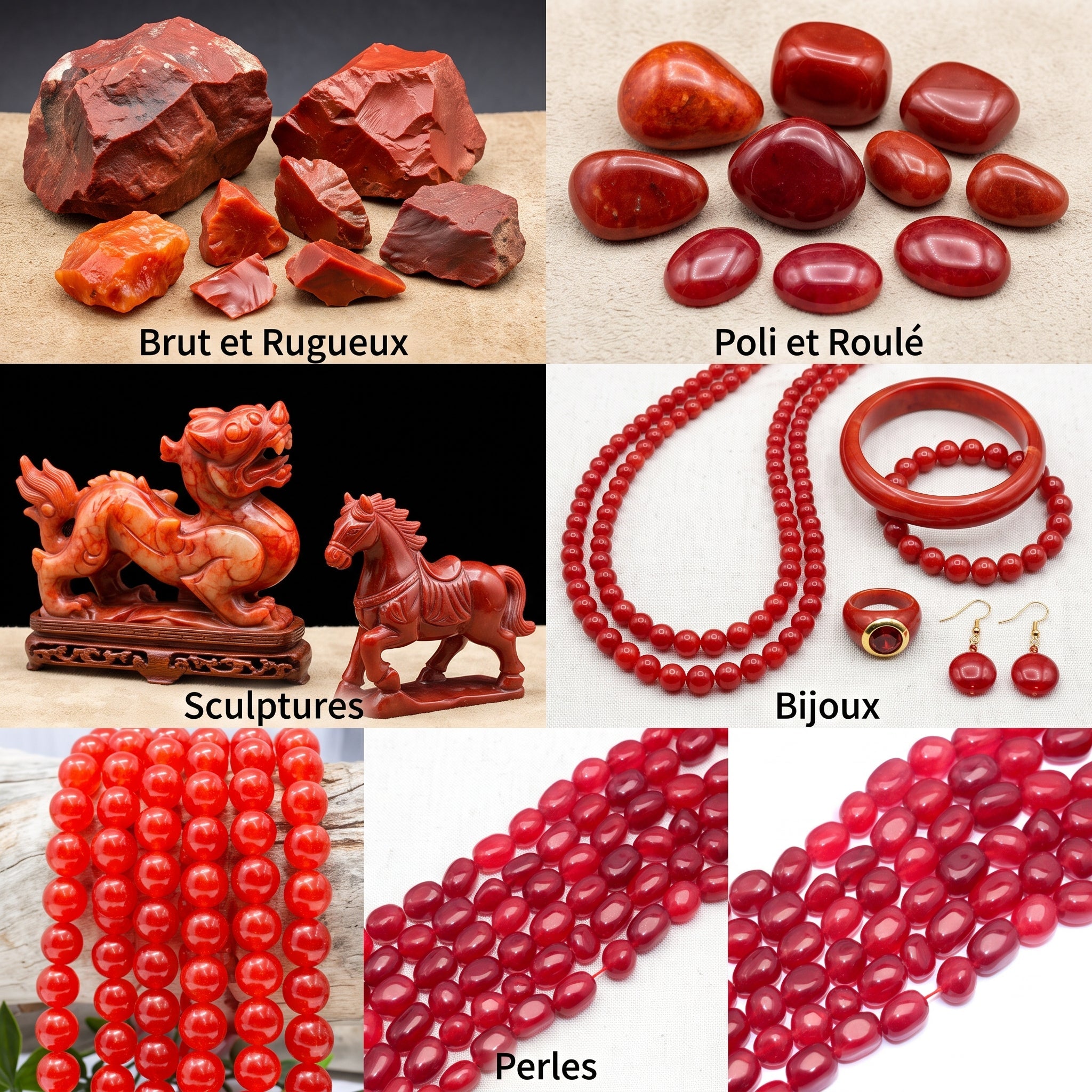
Uncover the geological secrets of red jade. Our expert gemological guide explores the profound cultural meaning of this fiery stone. Learn to scientifically distinguish between natural earth-forged...
A side-by-side comparison table of real and fake jade, covering weight, temperature, light, sound, and color — with links to the full step-by-step tests.