
The Flashlight Test: Reading Jade Under Light
Table des matières
Shining a phone flashlight through a piece of jade at an angle reveals an uneven, cloud-like fibrous texture in genuine jadeite or nephrite, versus round trapped bubbles in glass or a flat, uniform glow in dyed quartz or resin. It's one of the more reliable home checks, but it works best combined with the others — not as a standalone verdict.
Introduction
Shining a light through a piece of jade is one of the more informative physical checks you can do without any equipment. This guide covers exactly why it works, how to do it correctly, and — just as importantly — what it can't tell you on its own.

Why Light Behaves Differently in Real Jade
The flashlight test isn't a trick — it works because of a real, measurable optical difference between natural jade and its imitations.
What Does Jade's Crystal Structure Do to Light?
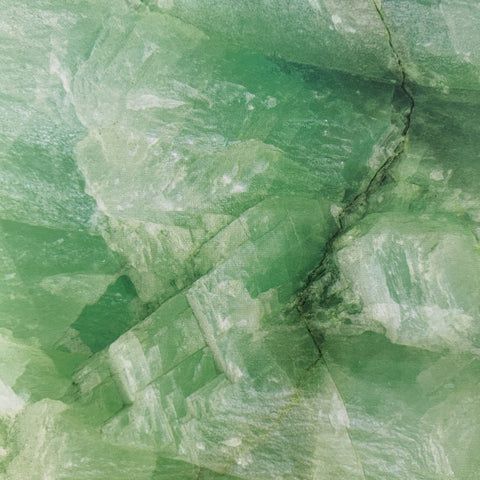
GIA notes that both jadeite and nephrite are made of tightly interlocked crystals — granular in jadeite, fibrous in nephrite. Light entering the stone scatters across all these internal boundaries instead of passing straight through, which is what produces the soft, cloudy look you're checking for.
How Does This Compare to Common Imitations?
Refractive index — how strongly a material bends light — differs enough between real jade and common substitutes to matter here: GIA data puts jadeite at roughly 1.66 and nephrite at roughly 1.61, while glass and dyed quartzite sit lower, around 1.55–1.56. The difference is too small to read directly with a flashlight, but it's part of why light travels through each material differently.
How to Do the Flashlight Test Correctly
No special equipment is needed — a phone flashlight and a dim room are enough, and the technique works the same whether you're a first-time buyer or checking an old family piece.
How Should You Position the Light and the Piece?
Turn on your phone's flashlight and hold the piece of jade directly against the lens, angled slightly rather than dead-on — a straight-through angle can wash out the texture you're trying to see. Cup your other hand around the contact point to block stray light from the room.
What Room Conditions Give the Clearest Read?
A genuinely dark room matters more than a powerful light. In a lit room, ambient light drowns out the subtle internal scattering that makes the test useful in the first place — even a bright phone torch won't show much detail with the lights on.
What You're Actually Looking For
Three specific patterns tell you most of what this test can reveal, and they're worth checking one at a time rather than all at once.
What Do Natural Fibers and Clouds Look Like?
Genuine jadeite or nephrite shows fine, irregular, thread-like internal lines that resemble wisps of cloud — never perfectly straight, never evenly spaced. This comes directly from the interlocked crystal structure described above.
What Do Bubbles and Artificial Swirls Look Like?
Round, evenly spaced bubbles, or smooth swirling patterns with sharp edges, are signs of glass. Natural jade doesn't produce perfectly round internal features — anything that looks machine-uniform is a red flag.
What Does Dye Pooling Look Like?
In dyed material (Type C), color often concentrates unevenly along internal fractures or surface fissures rather than following the stone's natural pattern — look for streaks of stronger color tracing thin cracks rather than blending smoothly into the surrounding material.

What This Test Can't Tell You
The flashlight test is a strong first filter, but it has real limits worth being upfront about.
What Does the Flashlight Test Miss?
It can flag an obvious glass or resin imitation, but it can't reliably distinguish Type A (untreated) jadeite from Type B (resin-impregnated) material — both can look reasonably clear under a phone light, and only lab-grade infrared spectroscopy reliably detects the resin used in Type B treatment.
Why Does a Certificate Still Matter?
For anything beyond a quick sanity check on a piece of jade, a written lab report — or a certificate of authenticity from the seller, which shops selling genuine jadeite and nephrite jewelry generally provide — remains the only way to confirm treatment type with certainty.
Conclusion
The flashlight test is quick, needs nothing but a phone, and reliably catches obvious glass or resin fakes by how they scatter light differently from real jade's interlocked crystal structure.
FAQ
Do I need a special UV or blacklight for this test?
No — a standard phone flashlight works. UV light is used for different purposes in gemology and isn't part of this particular check.
Can the flashlight test alone tell me if a piece is Type A or Type B?
Not reliably. It's good at catching glass or resin imitations, but distinguishing Type A from Type B jadeite generally requires lab testing (FTIR) rather than a visual check.
Why does the room need to be dark for this test to work?
Ambient light overwhelms the subtle internal scattering the test relies on — the same beam that shows clear texture in a dark room will show almost nothing with the lights on.
Does this test work on opaque or carved jade pieces?
It works best on translucent pieces like bangles, beads, and thin pendants, where light can actually pass through. Thick or heavily carved pieces may not transmit enough light to show internal texture clearly.
Is a cloudy appearance always a good sign?
Generally yes for natural texture, but a piece that looks uniformly hazy with no fiber-like detail at all can also indicate dense treatment fillers — the pattern matters more than cloudiness alone.
Read more
Uncover the quiet power of authentic black jade. Our gemological guide explores everything from unearthing raw black jade rough to understanding profound symbolism. Learn how experts accurately det...
A material-by-material look at what's actually sold as fake jade, and the traits — weight, hardness, price — that tell each imitation apart from the real thing.